The Electric Grid

America's Biggest Technological Bottleneck

Scroll or use arrow keys to explore

Watch our explainer video on the Electric Grid:

The Electric Grid: America's Biggest Technological Bottleneck

Table of Contents

  1. 01 Why the Grid Matters
  2. 02 How the Grid Works
  3. 03 Brief History of the U.S. Grid
  4. 04 8 Core Challenges
  5. 05 Emerging Solutions
  6. 06 Resource & Policy Drivers
  7. 07 Synthesis
The Electric Grid: America's Biggest Technological Bottleneck

About This Presentation

This is the first in a series of deep dives exploring energy, the most critical input powering civilization, improving quality of life, and driving technological progress.

This is an interactive experience. Charts respond to hover and touch. Audio clips provide commentary from the original presentation. Diagrams animate as you scroll. Use the navigation dropdown at the top to jump between sections.

We start with the electric grid: what it is, how it evolved, why it has become America's biggest bottleneck, and where it's headed over the next five years and beyond.

Next in the series: Solar Power
Coming Soon: Batteries

Subscribe to our Learn With Me Substack to get our latest Deep Dives:

Why the Grid Matters

Social Capital
Energy is not a climate change issue, it is a national security issue.
Why the Grid Matters

The Fundamental Variable

Electricity powers shelters, transportation, communication, and emergency services.

Modern civilization is heavily reliant on the grid to deliver that electricity.

When blackouts happen during high demand, problems cascade.

In February 2021, Winter Storm Uri overwhelmed the Texas grid. The result is shown on the right →

Source: Texas DSHS, Texas Monthly
Winter Storm Uri, Texas 2021 0 Deaths from a single storm
$100B+ Economic loss from that one event
Why the Grid Matters

The Fundamental Variable

Energy abundance and affordability are primary drivers of quality-of-life and capacity to do work. Life expectancy data from 1800–today reveals a strong correlation with rising global energy consumption.

Source: Our World in Data, Energy Institute – Statistical Review of World Energy (2025)
Why the Grid Matters

GDP vs. Electricity

Nations that consume more electricity per capita tend to have dramatically higher GDP per capita.

This isn't coincidence, electricity enables industrial output, technology, and services that drive economic growth.

This relationship is roughly linear, suggesting electricity access is a prerequisite for prosperity, not a byproduct.

Highlight Region
Source: World Bank, IEA (2024)
Why the Grid Matters

Bigger Was Better

The more energy generated, the more electric power there is to develop technological, economic, industrial, and military capacity.

From 1900 to 2000 the United States continuously grew total electricity generated.

Around the early 2000s, that changed. In a later section we will further explore just how and why this happened.

Source: U.S. Energy Information Administration
Why the Grid Matters

The U.S. Fell Behind

From 2000–2024, the amount of electricity generated in the U.S. stagnated around 4,000–4,200 TWh per year.

Efficiency gains have masked the lack of net growth.

Rather than expanding for future needs, power plants were retired (taken off line) as fast as new ones were built.

Source: Our World in Data, Ember (2025), Energy Institute
Why the Grid Matters

China Took The Lead

In contrast, China's electricity generation has exploded over 600% since 2000 to ~10,000 TWh per year in 2024, with build-out rates only accelerating to fuel economic and technological development.

China generated more electricity in 2024 than the U.S., EU, and India combined.

Source: Our World in Data, Ember
Why the Grid Matters

Upgrade Needed

The U.S. grid delivers ~1.3 TW of capacity to 340M+ Americans, but much of the infrastructure dates to the 1960s–70s.

Aging transmission lines, outdated transformers, and growing demand from electrification and AI are pushing the system to its limits.

The average age of a U.S. power transformer is over 40 years, past its designed lifespan.

Source: EIA, DOE, ASCE Infrastructure Report Card

Capacity Top Sources
Infrastructure Population

12

Every four years the American Society for Civil Engineers (ASCE) prepares a comprehensive Report Card on the state of America's Infrastructure.

In 2025 the ASCE rated U.S. Energy, including the grid, at a D+.

Source: ASCE Report Card
Why the Grid Matters

AI Has Ignited an Energy Race in the U.S.

On April 8th, 2025, President Trump issued Executive Order 14262:

"Strengthening the Reliability and Security of the United States Electrical Grid" aimed at bolstering resilience amid surging AI-driven demand.

Source: US DOE Resource Adequacy Report 2025

Key Takeaways:

  1. Status Quo is Unsustainable
  2. Grid Growth Must Match Pace of AI Innovation
  3. Retirements Plus Load Growth Increase Risk of Power Outages by 100x in 2030
  4. Planned Supply Falls Short, Reliability at Risk
  5. Old Tools Won't Solve New Problems
Why the Grid Matters
The grid is the backbone of America's prosperity and potential. To grasp the challenges faced, we need to understand what it is and how it works.

How the Grid Works

Social Capital
How the Grid Works

Electricity 101

What It Is: Electricity is the flow of electric charge (electrons) through conductive material that can be utilized to do work.

How It Works: Electricity delivers energy to power light bulbs, drive motors, provide heating and cooling, run data centers, and more.

How It Is Measured: In watts (W) for power or watt-hours (Wh) for energy used over time. Voltage (V) measures the electric "pressure" like water pressure in a pipe.

Fuel-Agnostic: Electricity can come from many sources but varies in method, reliability, and efficiency depending on the source and system.

16

Power Scaling

1 TW demand = country
supply = entire grid
1012 W
1 GW demand = city
supply = 1 nuclear plant
109 W
1 MW demand = modest factory
supply = 1 wind turbine
106 W
1 kW demand = Nvidia GPU
supply = 2 solar panels
103 W
1 W = a small LED 1 W
1.0 TW
How the Grid Works
America's electric grid is an interconnected network of power lines and components that generate, store, and transmit electricity from power plants and batteries to homes, businesses, and critical infrastructure.
Source: U.S. Energy Information Administration
How the Grid Works

Main Components of the Grid

Power Plants: Generate electricity from diverse fuels (coal, gas, solar, nuclear, wind, etc.) via different methods.
Transmission Lines: Power lines that carry electricity long distances at very high voltage to reduce losses.
Transformers: Change the voltage by 'stepping up' to high voltage for transmission or 'stepping down' for distribution.
Distribution Lines: Power lines that deliver low-voltage power to users and businesses, often atop wooden poles.
Power plant
generates electricity
3–30kV
Transformer
steps up voltage
Power Tower 138+ kV
Step-down
transformer
(substation)
Electric Poles 4–21kV
Demand or Load 120 & 240V
Scroll to see more
Source: NEED.org Electricity (2023)

19

How the Grid Works

The Largest Machine in the World

The U.S. has the largest interconnected electric power grid, considered the largest machine in the world.

The total length of power lines across transmission and distribution total more than 6 million miles.

More than 120 times all the U.S. Interstate Highways combined, and enough to circle the earth approximately 240 times.

How the Grid Works

Turbines Generate Electricity

Most electrical generation today begins with mechanical motion. Steam, water, or wind turns a turbine, rotating wire coils through a magnetic field to create electric current.

Coal and gas plants burn fossil fuels to heat water into steam. Nuclear plants split atoms to generate steam.

Hydro uses flowing water to spin turbines. Wind uses moving air.

Explore each component →

Source: ENEC Secondary Loop Components, 2024
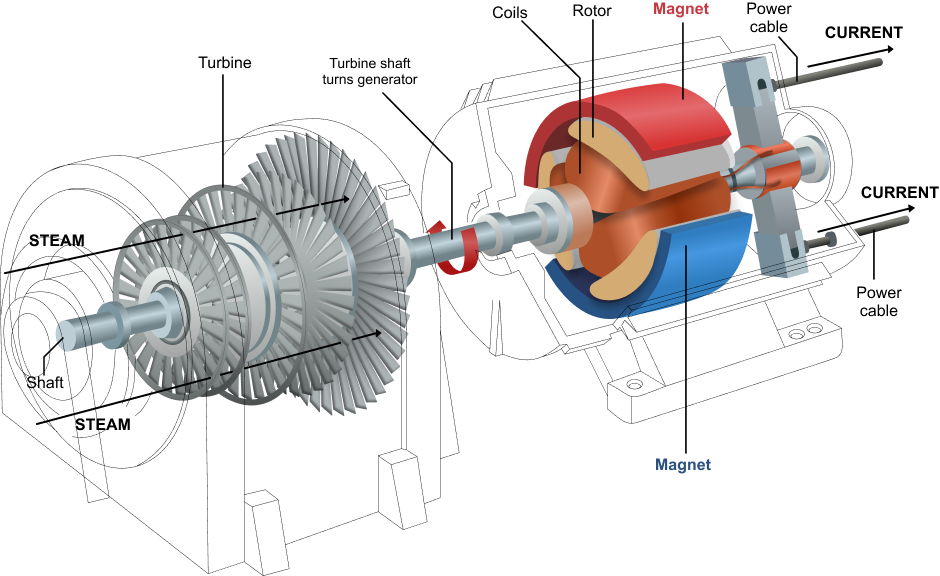
Turbine and generator cross-section showing steam, turbine blades, shaft, rotor, coils, magnets, and power cable
How the Grid Works

Solar: The Exception

Solar power is unique because it generates electricity without turbines or generators.

Photons from sunlight strike silicon semiconductors and knock electrons free, creating direct current (DC). An inverter converts this to alternating current (AC) for home and grid use.

No moving parts, no fuel, no emissions during operation.

Explore each component →

How the Grid Works

U.S. Electricity Source

The U.S. generation mix has shifted dramatically over time.

Coal dominated from the early 1900s until the 2000s, but has been in steady decline since 2008. Hydro power has been relatively stable and modest for the last 50 years.

Nuclear rose fast in the 70s and 80s and has since plateaued with no new reactors built for decades.

Today, natural gas reigns supreme driven by innovations in hydraulic fracturing. Gas produces twice as much electricity in the U.S. as any other source.

Alongside gas, wind and solar are the fastest growing net new generation capacity.

Source: U.S. Energy Information Administration
Toggle Sources
How the Grid Works

There is Plenty of Electricity... Most of the Time

The entire grid needs to be built to handle the highest load on the coldest and hottest day of the year.

Those relatively rare moments are called peak load, or in general the demand pattern is called peaking.

Most of the time, we already have far more power than we need to cover our base load of average demand. Especially in the spring and fall.

Until batteries can store massive amounts of power long term, the entire grid needs to support and survive peak loads. When the grid hits a supply-demand mismatch, critical problems arise.

Source: U.S. Energy Information Administration
Toggle Generation Sources
How the Grid Works

Supply Must Equal Demand

The grid must balance electricity supply and demand in real time, every second of every day.

The AC frequency (60 Hz in the U.S.) is the grid's heartbeat. When supply and demand are balanced, frequency holds steady.

If frequency drifts too far up or down, equipment disconnects automatically, triggering cascading blackouts.

Toggle the supply and demand below to see what will happen to frequency and the grid.

Supply Sources
Total Supply: 1,100 GW
Grid Demand
Total Demand: 1,100 GW
Source: NERC, DOE, Illustrative model
60.0 Hz
Stable

Grid frequency is nominal. Supply and demand are balanced.

27

How the Grid Works

Load Balancing

Load balancing is the process of instantaneously managing the supply of the electric grid at scale to match demand.

Too little or too much supply can cause blackouts. It is a complex and dynamic problem that grid operators manage every second of every day.

Batteries increasingly play an important role in smoothing short-term imbalances between supply and demand.

How the Grid Works

The Grid is Actually 3 Grids

The U.S. and Canada share the North American electric grid, which, in the U.S., is divided into three major regional grids known as interconnections.

High-voltage direct current (HVDC) lines connect these regions to balance supply and demand, but there are relatively few of them.

This fragmented structure, with only about 1.3 GW of transfer capacity between East and West, makes it harder to manage demand surges or share cheaper power between regions.

Aging and limited interconnections further strain system reliability.

Source: NERC Interconnections
Western
Interconnection
Eastern
Interconnection
ERCOT
Interconnection
How the Grid Works

Regulation is Complicated

Fragmented grid management and regulatory layers have created a multi-agency process that takes years for new projects to navigate.

There are multiple authorities, agencies, and operators spread across different hierarchies and functions.

No single authority can drive national grid modernization. A transmission line crossing state borders can require permits from dozens of agencies.

Hover a box to see its connections

31

The grid is a complex and dynamic system of components, operators, and authorities.

To understand why today's grid looks like it does, we need to see how it evolved and what challenges that created.

Brief History of the U.S. Grid

Social Capital

33

Brief History

From Edison to Today

New York City hosted the first commercial grid in 1882, thanks to Thomas Edison's Pearl Street Station.

In the 1930s, on the heels of the Depression, President Roosevelt's New Deal marked a dramatic acceleration of electrification with the Federal Power Act and the Rural Electrification Act.

In the decades that followed, dramatic and unexpected energy crises, blackouts, oil market crises, hurricanes, and storms, would stimulate policies and regulations.

This led to a patchwork system of complex technologies and regulations that define today's grid.

Brief History

Key Moments in Grid History

The Pioneers 1880 – 1930
1882 Pearl Street Station Edison opens first commercial power plant in NYC, serving 85 customers.
1886 AC vs. DC Westinghouse licenses Tesla's AC patents, the "War of Currents" begins.
1907 Insull's Monopoly Samuel Insull proves that larger grids = cheaper power, birthing the utility monopoly model.
1920 Federal Power Commission Congress creates the FPC to coordinate hydroelectric projects across state lines.
The New Deal Era 1930 – 1960
1933 TVA Created Tennessee Valley Authority becomes the nation's largest public power provider.
1935 Federal Power Act Creates federal regulation of interstate electricity sales and hydropower.
1936 Rural Electrification REA brings power to farms, only 10% had electricity in 1935, 90% by 1950.
1942 Manhattan Project Massive grid expansion to power secret nuclear facilities, Oak Ridge alone consumed more electricity than NYC.
Crises & Regulation 1960 – 2000
1965 Northeast Blackout 30 million people lose power. Leads to creation of NERC.
1970s Nuclear Build-Out Most of today's 94 nuclear reactors are built during this era.
1973 Oil Embargo OPEC oil shock forces America to rethink energy independence. PURPA follows in 1978.
1979 Three Mile Island Partial meltdown kills new nuclear orders for 30 years. 51 planned reactors are cancelled.
1996 FERC Order 888 Opens transmission access, creates competitive wholesale markets.
Modern Grid 2000 – Today
2003 Northeast Blackout 55M people, largest in N.A. history. A software bug cascades across 8 states.
2005 Energy Policy Act Establishes mandatory reliability standards and creates the modern regulatory framework.
2009 Smart Grid Push $4.5B stimulus investment in grid modernization and smart meters.
2021 Winter Storm Uri Texas grid nearly collapses. 4.5M homes lose power, 246+ deaths.
2022 IRA Signed Inflation Reduction Act commits $369B to clean energy, largest climate investment in history.
2025 Genesis Mission DOE executive order for AI-accelerated nuclear and grid R&D.
Brief History

A Century of Growth... Then Stagnation

Over 100 years, the total amount of new grid power capacity increased 900% every ~30 years.

In the last 25 years, net electric power on the grid has increased by only 30%.

From the late 2000s through 2024, total net electric power generation on the grid stagnated. Large amounts of new power were added (gas, solar, wind), but coal plants were decommissioned just as fast.

Source: U.S. Energy Information Administration

37

The development of the grid shifted from expansion to stagnation.

Components have grown old, approvals more complex, and the development process more time consuming and expensive.

Despite incredible innovation in multiple areas, the U.S. grid faces significant challenges over the next five years as demand surges.

8 Core Challenges

Social Capital
8 Core Challenges

1. Aging Infrastructure

The ASCE estimates a $578B investment gap to modernize the grid through just 2026.

70% of transformers and transmission lines are 25+ years old. 60% of local distribution lines are 40+ years old. 60% of circuit breakers are 30+ years old.

Aging equipment increases the likelihood and severity of blackouts and critical component failures.

Source: ASCE Infrastructure Report Card
$578B Investment Gap
70% Transmission 25+ yrs old
D+ ASCE Grid Rating
8 Core Challenges

2. Energy Conversion Losses

More than 50% of all energy consumed to generate electricity is wasted in conversion losses from fuel to electricity.

This is primarily due to the thermodynamic limits of thermal power plants (coal, gas, nuclear). Further losses occur in transmission and distribution.

For every 100 units of fuel, only about 33 reach your outlet.

Source: EIA U.S. Electricity Flow, 2024
8 Core Challenges

3. Extreme Weather Events

Major weather events pose the greatest risk to reliability due to increase in frequency, footprint, and duration.

In Louisiana, Hurricane Katrina destroyed more than 90,000 wood utility poles.

From 2020-2024, of the 62 large transmission outage events, 61 were weather related.

Source: NOAA, DOE
Filter by Type
8 Core Challenges

The Coming Power Gap

For the first time in decades, the U.S. is projected to have a significant increase in demand for electricity.

AI-fueled data centers, electric vehicles, and broad industrial electrification require a significantly larger and more dynamic grid.

Past 15 years: +285 TWh. Next 15 years: need +1,955 TWh. That is triple the forecast from just 2 years ago.

Scale Demand Drivers
AI & Data Centers 1.0x
Electric Vehicles 1.0x
Electrification 1.0x
Source: US National Power Demand Study, 2025
Power Gap by 2040 830 TWh Deficit
8 Core Challenges

5. Rising Electricity Prices

U.S. electricity prices have risen steadily for 50 years, with a sharp acceleration post-2020.

Residential rates have climbed to an average of 16.6 cents/kWh in 2024, up 30% from 2020.

Adjusting for inflation, real electricity costs had been declining for decades, until the post-COVID reversal erased 20 years of progress.

Source: U.S. Energy Information Administration
Sector
8 Core Challenges

6. Gas Turbine Bottleneck

Natural gas is the primary "bridge fuel" while renewables scale, but the supply chain for gas turbines is severely constrained.

The global order backlog for large gas turbines has stretched to 3-4 years as utilities and data center operators scramble to secure dispatchable power.

GE Vernova, Siemens Energy, and Mitsubishi control 90%+ of the global gas turbine market, a critical supply concentration risk.

Source: S&P Global, GE Vernova investor materials
3-4 yrs Order Backlog
90%+ Market Concentration
3 Major Manufacturers
8 Core Challenges

7. Transformer Shortage

Large power transformers (LPTs) are the backbone of the transmission grid, and there aren't enough to replace aging units or support expansion.

Lead times for large power transformers have extended to 2-4 years. Each unit costs $3-10M and weighs up to 400 tons.

The U.S. imports ~80% of its large power transformers, primarily from South Korea, Germany, and Mexico. Domestic production capacity is severely limited.

Source: DOE Transformer Security Report
80% Imported
2-4 yrs Lead Time
400 tons Weight per LPT
8 Core Challenges

8. The Interconnection Queue

Before any new power source can connect to the grid, it must go through an interconnection study process.

This queue has become a massive bottleneck: about 2,300 GW of generation and storage capacity are waiting, nearly 2x the entire existing U.S. grid capacity.

Only about 13% of projects that entered the queue from 2000–2019 were ever built. The average wait time has grown to 5+ years.

Source: Lawrence Berkeley National Laboratory

48

8 Core Challenges

Transmission: A Transportation Problem

Even when new generation is built, getting the electricity to where it's needed requires new transmission lines, which face their own approval and construction delays.

The best wind and solar resources are in remote areas far from population centers. Without new long-distance transmission, much of this clean power is stranded.

Building a major new transmission line in the U.S. takes 10-15 years on average, primarily due to permitting across multiple jurisdictions.

8 Core Challenges

Challenges Compound

These eight challenges don't exist in isolation, they reinforce each other in a vicious cycle.

Aging infrastructure increases weather vulnerability. Queue delays slow new capacity. Rising demand widens the gap. Supply chain bottlenecks make everything slower and more expensive.

Hover over any challenge to see how it connects to the others. The grid crisis is a systems problem, not eight separate issues.

Source: Social Capital analysis

Emerging Solutions

Social Capital

51

Emerging Solutions

Unlock Existing Backup Power

Across the U.S., businesses and institutions maintain an estimated 80+ GW of backup diesel and natural gas generators, sitting idle most of the year.

New policies and technologies are making it easier to connect these distributed resources to the grid during peak demand.

This represents one of the fastest and cheapest ways to add capacity, no new construction needed.

Emerging Solutions

Accelerate the Pipeline

In 2024, utilities and developers added a record ~46 GW of new utility-scale power capacity, dominated by solar (62%) and battery storage (26%).

If interconnection queue reforms succeed, the pipeline of approved projects could accelerate dramatically.

The U.S. needs to triple its annual build rate to meet 2030-2040 demand projections.

Source: EIA, U.S. Energy Information Administration

54

Emerging Solutions

Off-Grid Data Centers

Some of the largest AI companies are bypassing the grid entirely, building dedicated power plants directly adjacent to data centers.

Elon Musk's xAI built a 150 MW gas turbine facility to power its Memphis supercomputer cluster in under 4 months, faster than any grid connection could be approved.

Microsoft, Amazon, and Google are all pursuing similar behind-the-meter strategies with nuclear, gas, and solar.

Emerging Solutions

Solar: The Cost Collapse

Solar panel costs have dropped ~90% in the last 15 years, making solar the cheapest source of new electricity in most of the world.

This "learning curve" shows no signs of stopping, every doubling of installed capacity reduces costs by another ~20%.

Solar became cheaper than new coal in 2015 and cheaper than new gas in 2019.

Source: Our World in Data
Emerging Solutions

Global Solar Growth

Global solar capacity reached ~1,866 GW in 2024, with China installing more solar in one year than the U.S. has total.

China manufactures 80%+ of the world's solar panels, creating significant supply chain concentration risk.

The U.S. is responding with domestic manufacturing incentives under the IRA, but remains years behind in scale.

IEA forecasts consistently underestimated solar growth by 5-10x, reality is outpacing every prediction.

Source: IEA World Energy Outlook, BloombergNEF
Emerging Solutions

But Solar is Still Very Early

Solar accounts for about 7% of U.S. electricity generation today, up from virtually nothing a decade ago.

Solar was the #1 source of new electricity capacity added in 2024, comprising over 60% of all new utility-scale additions.

At current growth rates, solar could reach 20-25% of U.S. generation by 2035, but only with massive battery storage to handle intermittency.

Source: EIA, U.S. Energy Information Administration
Emerging Solutions

Battery Storage: 20x in 5 Years

U.S. grid-scale battery storage has grown from 1.5 GW in 2020 to over 30 GW in 2025, a 20x increase.

Batteries solve the intermittency problem: they store excess solar during the day and discharge during evening peak demand.

Battery costs have fallen 90% since 2010. At current prices, 4-hour lithium-ion storage is cost-competitive with gas peaker plants.

Source: EIA, BloombergNEF
Emerging Solutions

Nuclear: The Aging Fleet + SMR Hope

The U.S. has 94 operating nuclear reactors generating ~19% of electricity, the largest nuclear fleet in the world.

Most were built in the 1970s-80s and are nearing end of life. Life extensions have kept them running, but no new large reactors have been completed since 2023 (Vogtle).

Small Modular Reactors (SMRs) promise factory-built units at lower cost, but commercial deployment remains 5-10 years away.

Source: NRC, DOE
View
Emerging Solutions

Alternative Solutions

The Rocky Mountain Institute has identified alternative system technologies that could improve grid efficiency and offset near term load growth.

Power coupling is the co-location of power supply and demand behind-the-meter.

Upgrades to interconnections (more high voltage connections) would help to unlock constraints and offset new demand in the years ahead.

Distributed energy resources like batteries, electric vehicles and residential solar can support grid resilience long term but will require continued build out to reach grid scale impact.

Virtual power plants are modern power plants that use software to (virtually) connect many different types of power plants together.

Source: Rocky Mountain Institute
Projected U.S. Electricity Capacity Gap by 2035 ~270 GW
0%
0 GW offset

61

Emerging Solutions

The Supply Chain Transition

Every grid solution depends on critical minerals: lithium and cobalt for batteries, silicon for solar, rare earths for wind turbines, copper for everything.

Current supply chains are heavily concentrated in China and a few other nations, creating geopolitical risk.

The U.S. and allies are investing billions in domestic mining, processing, and recycling, but building these supply chains takes 5-10 years.

Resource & Policy Drivers

Social Capital

63

Resource & Policy

Natural Gas: America's Advantage

The U.S. holds the 4th largest proven natural gas reserves globally and is the world's #1 producer.

Abundant, affordable gas provides a reliable bridge fuel while renewables and storage scale. Gas plants can ramp up and down quickly to complement intermittent solar and wind.

U.S. natural gas production has grown 80%+ since 2005 thanks to the shale revolution, keeping domestic prices among the lowest globally.

Resource & Policy

Where the Resources Are

The U.S. has world-class solar and wind resources, but they're concentrated far from population centers.

The Southwest receives the most intense solar radiation. The Great Plains from Texas to the Dakotas have the strongest winds.

This geographic mismatch is why transmission infrastructure is the key bottleneck, we need thousands of miles of new high-voltage lines to connect supply to demand.

Source: NREL, DOE Wind & Solar Resource Maps
Resource

65

Resource & Policy

Policy Tailwinds

Three major pieces of legislation are reshaping the grid:

IIJA (2021): $65B for grid modernization, transmission, and clean energy demonstrations.

IRA (2022): $370B+ in tax credits for clean energy manufacturing, deployment, and domestic supply chains.

H.R.1 / Permitting Reform (2025): Streamlining environmental review and transmission siting to cut project timelines from 10+ years to 2-3.

Resource & Policy

The Genesis Mission

In 2025, the DOE launched Project Genesis, an executive order to use AI to accelerate nuclear energy R&D and grid planning.

AI-driven grid optimization could improve load forecasting, reduce transmission losses, and speed interconnection studies from years to months.

This signals a fundamental shift: the federal government treating grid modernization as a national security priority.

Resource & Policy

China's Supply Chain Dominance

China controls 60-90% of processing for nearly every critical mineral needed for batteries, solar panels, and wind turbines.

From cell manufacturing to cathode materials, graphite processing to lithium refining, China dominates every segment of the battery supply chain.

China's share of NMC battery components ranges from 71% to 96% across all major segments.

Source: BloombergNEF, IEA Critical Minerals

68

Resource & Policy

The Workforce Challenge

Building and operating the new grid requires a massive expansion of the skilled energy workforce.

The U.S. energy sector employed ~8 million workers in 2024, with clean energy jobs growing 3x faster than the overall economy.

The biggest bottleneck isn't just permits or equipment, it's finding enough electricians, lineworkers, and engineers to build and maintain the grid of the future.

Synthesis

Social Capital
The grid is the backbone of any nation state that aspires to technological leadership.

Military and economic primacy requires technological leadership. Technological leadership requires energy abundance. Energy abundance requires a modern, reliable grid.

This chain is not theoretical, it has defined the rise and fall of great powers for over a century.

72

A Lost Generation

From 2000 to 2024, the U.S. grid effectively stagnated. Total generation capacity grew only modestly as coal retirements offset new gas, wind, and solar additions.

Meanwhile, China built the equivalent of the entire U.S. grid, twice over.

The result: an aging, fragile, capacity-constrained system facing the largest demand surge in generations.

The U.S. grid is in critical condition.

74

AI Changes Everything

AI and data center demand is accelerating faster than any grid forecast predicted. This is the catalyst that transforms the grid from a maintenance problem to a strategic imperative.

Every major tech company is now an energy company.

The AI race is fundamentally an energy race.

76

The 5-Year Window

The next 5 years represent a critical window. Supply chain constraints (turbines, transformers, minerals) cannot be resolved overnight.

Policy shifts are accelerating permitting reform, but building actual infrastructure, power plants, transmission lines, storage, takes years.

The gap between what the grid can deliver and what the economy will demand is widening. Closing it requires coordinated action at unprecedented scale.

78

The Outlook

Despite the challenges, the U.S. has fundamental advantages: abundant natural gas, world-class wind and solar resources, a deep capital market, and the political will to act.

Solar will continue its cost decline and scale rapidly. Wind and batteries will follow. Gas will bridge the transition. Nuclear will provide baseload, if SMRs deliver on their promise.

The electric grid is America's most important piece of infrastructure. Modernizing it is not optional, it is the foundation of everything that comes next.

80

Coming Soon

This is the first in a series of deep dives exploring energy and its implications.

Next in the series: Solar Power
Coming Soon: Batteries

Subscribe to our Learn With Me Substack to get our latest Deep Dives: